



Table of Contents
A few years back, the founder flex was a watch, or a car with a driver waiting outside. Lately it’s turned into something you can’t show off in a parking lot. It sits in your camera roll instead, and a lot of the time it got shot at six in the morning somewhere in East Africa. A Masai Mara safari from India has become the trip a certain kind of Indian operator takes after a big funding round, or an ESOP payout that finally cleared.
I’ve seen this up close. I took one of these trips myself, and half the people I met out there sounded like they’d walked off a Koramangala cap table.
Why the savannah, and why now
Two forces are pushing in the same direction. There’s money, and there’s the fact that everyone is tired.
The money side shows up in the data. India has become a market Kenya’s tourism board is openly going after, and you can see why. Kenya brought in 2.7 million international visitors in 2025, up about 9% on the previous year, while the global average sat closer to 4%. Indian founders are still a thin slice of that, but a fast-growing one that spends.
The tiredness is harder to dress up. Founder burnout used to be a 2am admission. Now Harvard Business Review writes about it openly, including how founders burn out because they’ve fused their identity to the mission. If you are your company, a few days in Goa won’t fix much, because you’ll be answering Slack from the sunbed. The bush works differently. Large parts of the Mara have no signal at all, and that dead phone is more or less what you’re paying for.
There’s a business story under this too. Travel tech in India is on a tear, with startups in the category pulling in $127 Mn in the first half of 2025, up 57% from a year earlier. High-touch outbound travel rides along with that, and the safari sits at the flashy end. Direct Mumbai–Nairobi flights have made the whole thing far less of a project, and plenty of operators now just hand the planning over, using safari itineraries built for Indian travellers so the food and logistics get sorted before anyone touches down.
The morning the laptop stayed shut
On my second day, we rolled out of camp while it was still dark. Cold, too. Properly cold, which nobody expects, because who packs a fleece for Africa. We had blankets over our knees and bad instant coffee going cold in steel mugs.
Our guide, Patrick Kuya, who’s licensed and has read these plains for ten years, cut the engine on a low rise and let us sit. It arrived in pieces. The smell first, wet grass and dust with something mineral under it, the way the air goes before the sun is fully up. Then a hyena off to the left somewhere, doing that long rising whoop that doesn’t match any animal you think you know.
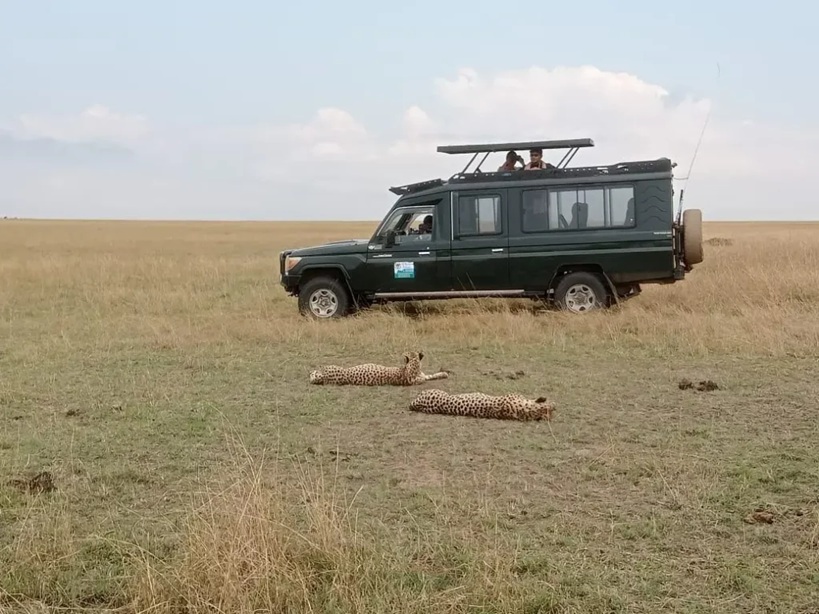
The sky went orange behind the Masai Mara National Park, and a cheetah crossed the track about thirty feet ahead of us, not bothered by the jeep in the slightest. The founder next to me, a guy who checks his dashboard in his sleep, didn’t reach for his phone once. He told me afterwards it was the first hour in two years he hadn’t thought about runway. I didn’t have anything clever to say back. It was just a good hour.
The numbers nobody puts in the brochure
Here’s the unglamorous part. What the brochure quotes and what you hand over at the gate aren’t the same, and the gate prices went up in 2026.
The Masai Mara charges fees set by the county, and they swing with the season now. A non-resident adult (an Indian passport counts as non-resident, and no, there’s no discount for us) pays USD 100 per person per day from January through June, then USD 200 a day from July to December, which is when the wildebeest migration is on. Nine to seventeen-year-olds are USD 50. Under-eights get in free. Card or M-Pesa only, no cash, and your ticket covers twelve hours, roughly 6am to 6pm.
Nairobi National Park is a separate animal, run by the Kenya Wildlife Service, and most people slot it in as a half day on one end of the Mara trip. Its fees rose in late 2025 for the first time in eighteen years. Non-resident adults now pay USD 80, kids USD 40, through the KWS portal at kwspay.ecitizen.go.ke. Two things to know before you plan the day. It’s single-entry, so if you nip out for lunch, you’re buying another ticket to get back in. And there’s not one elephant in the park, which catches almost everyone off guard. What you do get is lions and giraffes with the Nairobi skyline standing right behind them, which is a strange, brilliant thing to photograph.
Park fees are only one line in the budget. It pays to look hard at what a Masai Mara trip really costs before you commit, and a proper breakdown of safari pricing will tell you fast whether you’re looking at the price of a luxury week in Europe. You mostly are. A balloon ride over the plains is another USD 450 or so per person. Check the live rates on the official KWS site before you lock anything in, because they shift, and I’d rather you didn’t take my word as gospel.
Three things that catch first-timers out
“Visa-free” doesn’t mean what you think. Kenya scrapped visas for Indian passport holders. You still need an eTA, an electronic travel authorisation, cleared online before you fly, and it takes a few days to come through. It’s around USD 34. No eTA, no boarding. I’ve watched people leave it dangerously late.
Spell out what “veg” actually means for you. Camps generally do vegetarian food fine, and some Mara lodges, Keekorok being the obvious one, are owned by Indian-linked chains and put out full Indian spreads. There’s a catch people rarely warn you about, though. “Vegetarian” in a Kenyan kitchen usually still includes onion and garlic, and often potato. If you keep a strict Jain diet, that has to reach the camp in writing before you travel, not at the table when you’re already hungry and irritated. masaimarasafari.travel and a few others build this into the booking now, which saves the whole sorry conversation.
The bush plane will turn away your hard suitcase. This one I watched happen, and it’s my favourite. A founder in our group showed up at Wilson Airport with a hard-shell case about the size of a bar fridge. The pilot looked at it once and said no. Those small Cessnas take soft duffels only, usually capped around 15kg including whatever you’re carrying on. He repacked his bag on the tarmac into a borrowed canvas holdall while the rest of us found something else to look at. Pack soft, pack light, weigh it before you leave home.
One last thing, if you’re booking it for the team
If this is a trip for your people and not just you, don’t run it like an offsite with a lion theme. The Mara doesn’t care about your agenda. Drives go out when the light’s good, not when the calendar says so. Leave room in the plan, get everyone sorted on luggage and the eTA well ahead of time, and let the operator handle the food before anyone lands.
And drop the idea of making the trip “productive.” The founders I met who treated it like a working retreat got almost nothing out of it. The ones who put the phone in a drawer came back different. That’s the version worth booking.